- Details
- Category: 1870s Baseball Recaps
1876 Century League Recap: Centennials & Unions Dominate, Chaos Erupts in Cincinnati and St. Louis
In the centennial year of the nation, America’s newest professional base ball league launched with thunderclap ambition and no shortage of drama. The Century League, founded by Chicago industrialist and former Union officer William Washington Whitney, brought together eight clubs from the country’s largest cities — and by season’s end, not all of them would remain in the fold.
Philly Sets the Standard
From the outset, it was clear that Jeff Edgerton’s Philadelphia Centennials were a cut above. Backed by financial discipline, tactical consistency, and relentless offensive pressure, the Cents closed the season with a 43–17 record, playing dominant baseball before ending the season on a sour note by refusing to finish their final road trip. Edgerton cited "fatigue" and that his club had sewn up the pennant. This turned out not to be true: while the Cents remained home, the Brooklyn Unions finished their own schedule to the tune of a 46-20 mark, tied by today's standards, but losing out by having a winning percentage of .697 to Philadelphia's gaudy .717 winning percentage.
Boston- which also played all its games - was third at 47-23, with a .671 winning percentage. If having three powerhouses leads you to conclude there had to be some bad teams... well you're right. Whitney's club, the Chicago Chiefs, rounded out the "good" clubs by posting a respectable 39-26, .600 season. But the bottom fell out after that. The St. Louis Brewers went 28-36, followed by the Detroit Woodwards (23-46), Cincinnati Monarchs (20-49) and at the bottom of the heap: the putrid New York Knights (14-43). The Knights, like the Centennials, didn't complete the schedule. They offered a similar excuse, but the real reason was that ownership (Charles Bigsby) didn't want to spend the money to send the club west.
Tension Turns to Turmoil
After a promising (if uneven) debut season, the real drama came late — in the form of a mutiny.
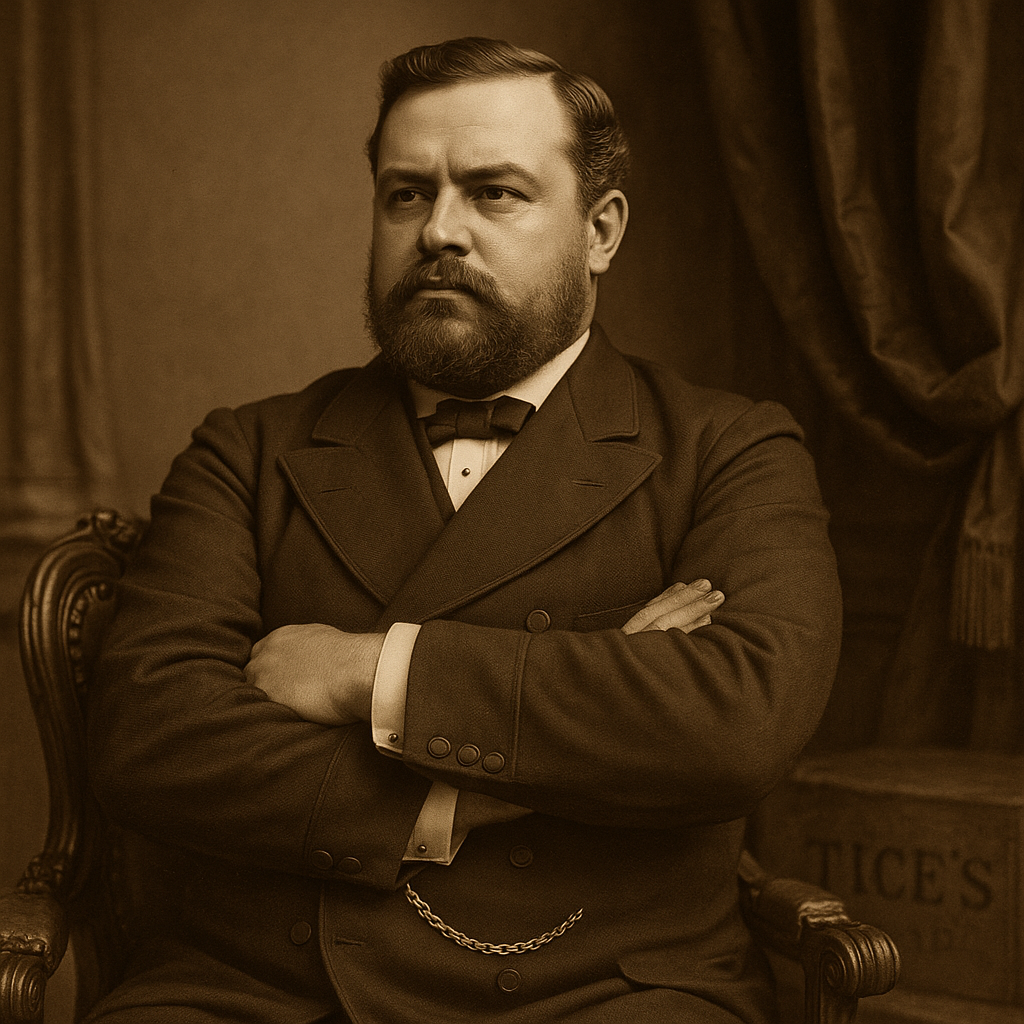
James P. Tice, circa 1876
Before the Century League could reach its first anniversary the brewing resentment among two of its club owners came to a head. The issue was perceived the special treatment for the Philadelphia and New York clubs at the expense of the Cincinnati and St. Louis clubs. Considering that New York and Philadelphia were the two largest cities in the country and that meant more potential customers, it was no surprise that a shrewd businessman like William Whitney would not want to leave those cities open.
This bottom-line reasoning was not good enough for James Tice of Cincinnati and Hans Fuchs of St. Louis. They stood on the agreement upon which the league had been founded that all clubs guaranteed to finish their complete "championship" schedule. Since both New York and Philadelphia neglected to do so, Tice & Fuchs believed they should be expelled from the league. Whitney refused to do so, instead opting for a guarantee from Charles Bigsby (NY) and Jeff Edgerton (Philly) to not repeat themselves or face expulsion.
Thus thwarted, Tice and Fuchs removed their clubs from the Century League and would "operate as independent touring clubs" instead. So the Century League embarked on it's 1877 campaign with only six clubs.
Interestingly, this would not be the last the baseball world would hear from Tice & Fuchs. It also prevented the strangling at birth of one of the two oldest existing professional clubs as today's Philadelphia Keystones trace their history back to that 1876 Philadelphia Centennial club that defied the league rules by not completing its schedule. New York would be another matter, but that's a story for another day....
- Details
- Category: 1870s Baseball Recaps
Those who may have wondered if the Century League would be yet another in a series of failed baseball leagues received their answer in 1877. Though staggered by the loss of two of its western outlets in Cincinnati and St. Louis, the league soldiered on and turned in a good and competitive second campaign.
The league's two weakest clubs in '76 were much improved in their sophomore campaigns. Both Detroit and New York rose from the bottom two spots and came close to claiming the pennant. What stood in their way was the fourth-place finisher of the season before - Chicago.
William Whitney's club was also improved from the season before and that improvement took them to a 40-20 record and the 1877 championship. With John Martin (.335) and Joe Whitcomb (.320) leading the way, the Chicago bats were good enough to take advantage of the outstanding pitching of Pat Murphy (21-10, 2.79) and Lou Allerton (19-10, 2.70) in finishing six ahead of Detroit and seven up on New York.
There would be no repeat title - disputed or not - for Boston, who finished fourth with a 31-29 record despite the presence of Bill Badway who broke onto the scene with a .376 average (good for 2nd place behind Detroit's Leonard Ziegler who hit a robust .392 and became the first player to reach double-figures in home runs with 14 for the Woodward club). Philadelphia saw many of its players leave and their replacements left a bit to be desired sending the Centennials tumbling into fifth place at 23-37. Brooklyn also fell hard, dropping to a 19-41 mark.
New York's Samuel Schuyler, a rookie chucker from Dayton, Ohio led the league in both ERA (1.90) and strikeouts (168) and was the key reason the Knights turned their fortunes around so greatly.
Whitney reveled in the success of both his club and his league, and at least for 1878, would stay the course and not add any new clubs to replace the departed Cincinnati and St. Louis teams.
- Details
- Category: 1870s Baseball Recaps
1878 Century League Season Recap
Final Standings:
| Team | W | L | PCT | GB |
|---|---|---|---|---|
| Brooklyn Unions | 48 | 13 | .787 | - |
| Chicago Chiefs | 33 | 28 | .541 | 15.0 |
| Philadelphia Centennials | 31 | 31 | .500 | 17.5 |
| New York Knights | 30 | 31 | .492 | 18.0 |
| Detroit Woodwards | 22 | 41 | .349 | 27.0 |
| Boston Pilgrims | 20 | 40 | .333 | 27.5 |
For 1878 the Century League returned the same six clubs it had the previous year. The results however, could not have been different. Embarrassed and angry after a dismal season in 1877, Miles Bigsby opened his wallet and remade his Brooklyn Unions. And it worked.
The new-look Unions turned it around completely, dominating the league to the tune of a 48-13 record and a fifteen-game margin over second-place Chicago (33-28). The Union Club had unearthed not one, but two stellar 21-year-old rookie pitchers in Buster Scott (25-8, 1.23) and Jim Cannon (23-5, 1.57). The offense was top-notch as well, finishing atop the circuit in runs scored (396), batting average (.300) and virtually every other category. Another rookie, 24-year-old Canadian outfielder Bob DeVilbiss left his Toronto club for Brooklyn and posted a .390 average (tops in the league) while also leading the league in runs scored, RBIs, home runs and pretty much every advanced stat (once the historians got around to working this out a hundred-plus years later).
DeVilbiss was supported by fellow rookie 3B Scott Wilkes (.336) and Detroit import Leonard Ziegler (who was sold to Brooklyn in the offseason by the cash-strapped Woodwards) who hit .335 a year after leading the league with Detroit. Every regular in the lineup hit over .300 with the sole exception of shortstop Lloyd Brumback. It was the most dominating performance in the three-season history of the Century League.
Brooklyn's dominance overshadowed everything else, including a fine season by 1877 champion Chicago. Whitney's men had good pitching with Will Ryan and Henry Walsh, both of whom were sub-2.00 in ERA, but the offense sputtered, finishing without a single .300 hitter and ended up last in the league in runs scored. Third-place went to Philadelphia who finished at 31-31. New York was just behind at 30-31. The also-rans were Boston (20-40) and last-place Detroit (22-41), which was suffering through financial difficulties.
Off the field, CL President Whitney spent much of his summer trying to find replacement clubs to get his circuit back to the eight he believed was the ideal membership level. Ironically, he found them amongst the ranks of the independent and relatively informal barnstorming group that Cincinnati and St. Louis had joined.
- Details
- Category: 1870s Baseball Recaps
1879 Century League Season Recap
Final Standings
| Team | W | L | PCT | GB |
|---|---|---|---|---|
| Brooklyn Unions | 59 | 20 | .747 | - |
| Chicago Chiefs | 57 | 26 | .687 | 4.0 |
| Philadelphia Centennials | 41 | 36 | .532 | 17.0 |
| Boston Pilgrims | 41 | 43 | .488 | 20.5 |
| Milwaukee Brickers | 39 | 46 | .459 | 23.0 |
| Cleveland Cuyahogas | 34 | 47 | .420 | 26.0 |
| Detroit Woodwards | 28 | 54 | .341 | 32.5 |
| New York Knights | 22 | 49 | .310 | 33.0 |
For 1879, William Whitney was determined to find two new clubs for the Century League; the goal was to have eight teams in the loop and the desertions of Cincinnati and St. Louis had meant playing the 1878 season with six. Though both Cincinnati and St. Louis were still intact and playing independently of the Century League, Whitney did not approach either of them but looked for other quality independent clubs. He found two - and though neither was good enough to actually challenge for the pennant, both finished ahead of two of the existing clubs in their first season.
The newcomers were the Milwaukee Brickers and the Cleveland Cuyahogas. Both had been straddling the line between amateur and professionalism for several years and Cleveland in particular had a strong reputation. Milwaukee turned out to be slightly better in 1879, going 39-46 and finishing in fifth place while Cleveland posted a 34-47 mark and a sixth-place finish. Cleveland did have two standouts in SS Ned Dupree who finished 2nd in the batting race (.363) and pitcher/1B Martin Tucker who was third in ERA (1.45). Milwaukee one-upped Cleveland by boasting the league's batting champ, 2B Charlie Dozier (.365).
Brooklyn returned to the top of the standings with a 59-20 mark and did it with a roster vastly different from that of their previous championship club. Citing costs, Miles Bigsby had shipped out much of his high-priced talent and replaced them with cheaper, but still productive, players. Foremost among these players were a pair of pitchers found in Syracuse, NY. 25-year-old pitcher Billy Roberson made 38 starts, posted a 31-7 mark, a 1.39 ERA and 299 strikeouts - all three were league-bests. Jimmie Williams, at age 22, made 41 starts, posted a 28-13 mark and a 2.15 ERA. Brooklyn appeared set for years to come - if they could afford to keep their new stars.
Chicago finished second again, this time with a very strong 57-26 record. New 1B Sam Sorenson, a 25-year-old plucked from the St. Louis touring club (Whitney likely enjoyed sticking it to one of his rebellious former comrades) hit .362, good for third place in the batting race and also a league-best 8 home runs. With Hartigan O'Carroll (14-11, 2.63) nursing a sore arm through much of the summer, newcomers Elmer Manuel (20-6,1.71) and Willie Davis (19-3, 1.41) picked up the slack. Manuel also played right field when not pitching and hit a solid .330 for the year.
Philadelphia finished third at 41-36, followed closely by Boston (41-43) and the two new clubs. Detroit, still struggling financially, finished seventh with a 28-54 mark and New York was in the basement with a 22-49 record.