- Details
- Category: Baseball
In the spring of 1876, as the United States celebrated its centennial and cities from Boston to St. Louis buzzed with parades and patriotic fanfare, a quieter kind of revolution was taking shape, one with leather balls, hand-cut bats, and handbills pasted to wooden fences. It was called the Century League, and it was the dream of a war-tested engineer from Illinois who believed that base ball could be more than just an idle pastime. He believed it could be an institution.
That man was William Washington Whitney.
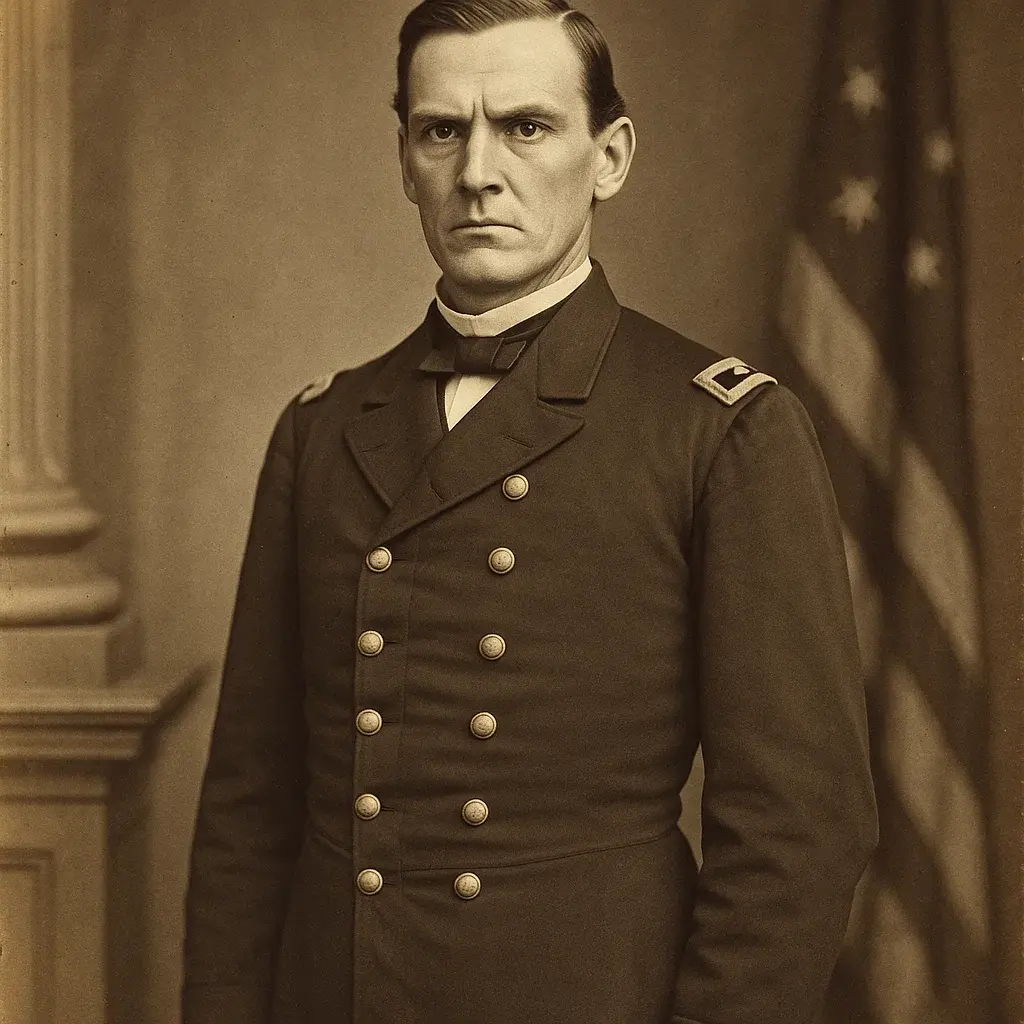
Born in Springfield, Illinois in 1833, Whitney had the kind of upbringing that molded men of action. The son of a surveyor and grandson of a Revolutionary War soldier, Whitney earned his appointment to West Point in 1851 and graduated four years later with a commission in the Corps of Engineers. Quiet, serious, and detail-minded, he was a man better suited to planning bridges than making speeches. But when the war came, he didn’t hesitate.Whitney served with distinction in the Western Theater, fighting under Ulysses S. Grant and later William T. Sherman, building pontoon crossings and reinforcing battle lines from Shiloh to Vicksburg to Atlanta. By the time he mustered out in 1865, he wore the eagle of a Colonel and had the ear of some of the most powerful men in uniform.
He also had a friend, a rare thing in wartime, named Jefferson Edgerton.
Edgerton was an unusual figure: a Virginian by birth, a loyal Union man by choice, and a year behind Whitney at the Academy. Where Whitney was deliberate and plainspoken, Edgerton was cool-headed and eloquent, an artillery officer whose courage at Shiloh and Chickamauga earned respect even from skeptical Northerners. While many of his Southern-born peers cast their lot with the Confederacy, Edgerton stayed. “I took my oath at West Point,” he later said. “It was not made in jest.”
After the war, the two men went their separate ways, Whitney back to Illinois, Edgerton to Philadelphia. Whitney took a position with a Midwestern railroad, applying his engineering skills to the postwar infrastructure boom. Edgerton opened a leather goods and sporting supply shop, his passion for base ball, cultivated among the camps and cannon, finding new life on the streets of a thriving industrial city.
Unbeknownst to one another, both men drifted into base ball from opposite ends of the map. Whitney, ever the organizer, began gathering the disparate barnstorming clubs and fledgling nines that dotted the Midwest. By 1874, he was convinced that only a formal league, with structure, integrity, and financial stability, could give the sport a future. He called it the Century League, in honor of the coming national milestone. The idea: eight teams, professionally operated, playing a set schedule with a league office in Chicago.In the spring of 1875, he called a meeting of club representatives to take place at the Sherman House Hotel in Chicago. Seven men arrived, rough-edged promoters, gentlemen of fortune, and businessmen of varying ambition. But it was the eighth man who gave Whitney pause: a well-dressed Philadelphian with a cavalryman’s mustache and a knowing smile.
Jeff Edgerton.
The reunion was immediate. “You might have warned me you were founding a league,” Edgerton quipped. Whitney only laughed. “You might have warned me you’d be running a club.”
Together again, this time in peace, the two men helped shape the first season of organized professional base ball in American history.The eight original clubs paid a $500 admittance fee, a princely sum for the time. But money wasn’t the only thing these men brought to the table.
From Boston, Ezra Barzillai Whitcomb, a stern dry goods magnate and moralist, brought his Pilgrims to the fold, seeing base ball as a civilizing force for the masses. In Brooklyn, former dockworker turned labor kingpin Frank Braddock formed the Unions, a workingman’s club with a blue-collar edge.Chicago belonged to Whitney himself. The Chiefs were his flagship, his blueprint for what a proper ball club should be. But just across the Ohio, James Pembroke Tice had other ideas. The Cincinnati Monarchs were the creation of a soap baron with a gift for self-promotion and a stubborn streak that clashed almost immediately with Whitney’s iron sense of order. “If anyone’s building a base ball empire,” Tice said, “it ought to be me.”Detroit’s entry, the Woodwards, came courtesy of Horace Delano Sutherland, a conservative shipping baron more interested in balancing ledgers than winning games. New York was represented by the Knights, a stately club bankrolled by Wall Street heir Lucius Belmont, whose polo connections and social calendar gave the league a touch of polish.
And in St. Louis, German-born brewer Adolph Fuchs offered something else entirely: beer. Fuchs got around Whitney’s “no alcohol in ballparks” edict by installing a full beer garden behind the grandstand, accessible via tunnel. Technically separate from the seating area, it became the liveliest, and loudest, section in the Century League.
By April 1876, with uniforms pressed and timetables drawn, the Century League launched its inaugural campaign. For base ball fans between the Mississippi and the Atlantic, it was more than just a game.It was structure. It was pageantry.It was summer, finally made official.And it all began with a West Point engineer, a Southern loyalist, and the belief that America’s pastime deserved a league worthy of its name.
- Details
- Category: Baseball
Figment League Baseball Rules
Mission Statement: Figment League Baseball aims to ensure fun for all participants, relying on collaboration between GMs and the commissioner. These rules provide a flexible framework to support enjoyable play.
Simulation Engine:
- Out of the Park Baseball (OOTP) is used for simulations.
- All GMs must own the current OOTP version.
- League upgrades to new OOTP versions at season-end when a new version is available.
General Rules
GM Participation:
- GMs are expected to submit exports regularly, stay active on Slack and the forum, and respond to trade discussions.
- The commissioner may replace absentee GMs or those who fail to treat others fairly.
Sim Schedule
- Simulations occur Monday through Friday, with exports due by 5:30 am Eastern time.
Sim Period:
- Each simulation covers one week of time, year-round, with the exception of the postseason as detailed below.
- Postseason simulations are split into two games per period with the seventh game (if necessary) getting its own sim.
Collective Bargaining:
- No work stoppages; the Reserve Clause remains until free agency's historical introduction in the 1970s.
Finances:
- Finances impact signing draftees and free agents, purchasing players from independent leagues, and managing staff, development budgets, and payroll.
Trading:
- Trades are processed at the end of each simulation period, except for the trade deadline simulation.
Independent League Player Acquisition:
- Major league teams can trade with an independent team once per calendar year.
- Offers must be made via DM to the commissioner.
- Only one player can be acquired per transaction, with a maximum of two offers per year.
- Trades can involve players or cash but not draft picks.
Free Agency
Introduction of Free Agency:
- Free agency will begin in the 1970s.
- Specifics will be provided closer to the start date.
GM Firing System
Conditions for Firing:
- GMs can be fired based on team performance and AI owner's mood.
- Conditions include consecutive seasons of poor finishes and owner's anger.
- Winning championships or pennants grants grace periods and resets firing clocks.
- Fired GMs can move to other teams or independent/Japanese teams if available.
Amateur Draft
Draft Phases:
- First 10 rounds occur in January before the players generate their latest statistics.
- Rounds 11-20 occur in June with updated statistics from the latest College & HS season.
- Draft order for first two rounds is lottery-based; subsequent rounds follow performance-based order.
- Order is also based on association with the picks alternating; Federal Association picks first (and third, fifth, etc.) in even-numbered years, the Continental in odd-numbered years.
Draft Lottery:
- Chances for lottery are based on improvement season-over-season in the just completed season and the one prior to it.
- Each association's two most-improved teams (by won-lost record) will receive three "Lottery balls" (or chances).
- Third and fourth-most improved receive two chances; other teams receive one each except the pennant winner who receives no chances and picks last in their association.
Draft Execution:
- January phase is conducted via StatsPlus, with a time-slotted draft followed by in-game completion.
- June phase is completed in-game; GMs may submit lists via export in OOTP.
- Drafted players must be signed; unsigned players return to the pool without compensatory picks.
Trading
Trading Rules:
- Permitted between the end of the World Series and July 31st.
- Trades can involve players and cash, but not draft picks. Finances must not be illegal following the trade.
- Both GMs must confirm trades on Slack, detailing players involved.
- Waived players cannot be traded. DFA players can.
- Drafted players cannot be traded within their first calendar year.
Multi-Sport Stars (The "Charlie Barrell Rule")
As FABL is part of a multi-sport universe there will occasionally be athletes who have the ability and option to play multiple sports. There are special rules, some of them morale-based, for dealing with these players.
- Players who do not consider baseball to be their primary sport will have contracts that allow them to miss portions of the FABL season (they will be listed as "injured" during these times). This is also true for the basketball, hockey and football leagues.
- In FABL, if a player's morale is "Unhappy" or lower he may elect to exercise the clause to go to another sport. Conversely, if the player's morale is good, he is more likely to remain with his FABL club.
- If a player's morale reaches "Angry" he may retire from baseball to concentrate on his other sport(s).
Subcategories
Bios
Biographical sketches of some of Figment baseball's biggest names. From owners, to skippers, umps and players - they're all here.